Why is yoga simple to start, you ask? No gym membership or expensive equipment is needed. You just need a space to roll out a mat. Some people also include yoga blocks and a yoga strap to enhance their time on the mat. Yoga is a great, well-rounded practice. It works on flexibility, focus, and strength. There is no one body type that yoga is for. With some modifications, many people can benefit from yoga. In this blog, I will help point you in the direction to get started on your own yoga journey.
Embracing Yoga: Starting Simple for Lasting Practice
To help you on your yoga journey, here is a beginner-friendly yoga pose list. This list includes a combination of standing and floor poses.
Favorite Beginner Poses
- Mountain Pose (Tadasana)
- A foundational pose that promotes good posture and grounding helping to focus the mind.
- Downward-Facing Dog (Adho Mukha Svanasana)
- Great for stretching the spine, hamstrings, and calves.
- Child’s Pose (Balasana)
- A restorative pose that helps to calm the mind and relax the body.
- Cat-Cow Stretch (Marjaryasana-Bitilasana)
- A gentle flow that warms up the spine and relieves tension in the back.
- Warrior I (Virabhadrasana I)
- Strengthens the legs and opens the hips while improving focus.
- Bridge Pose (Setu Bandhasana)
- Strengthens the back and glutes while stretching the chest and spine.
- Seated Forward Bend (Paschimottanasana)
- Helps in stretching the back and hamstrings.
- Cobra Pose (Bhujangasana)
- Strengthens the spine and opens the chest and shoulders.
- Triangle Pose (Trikonasana)
- Enhances flexibility and stability while improving overall balance.
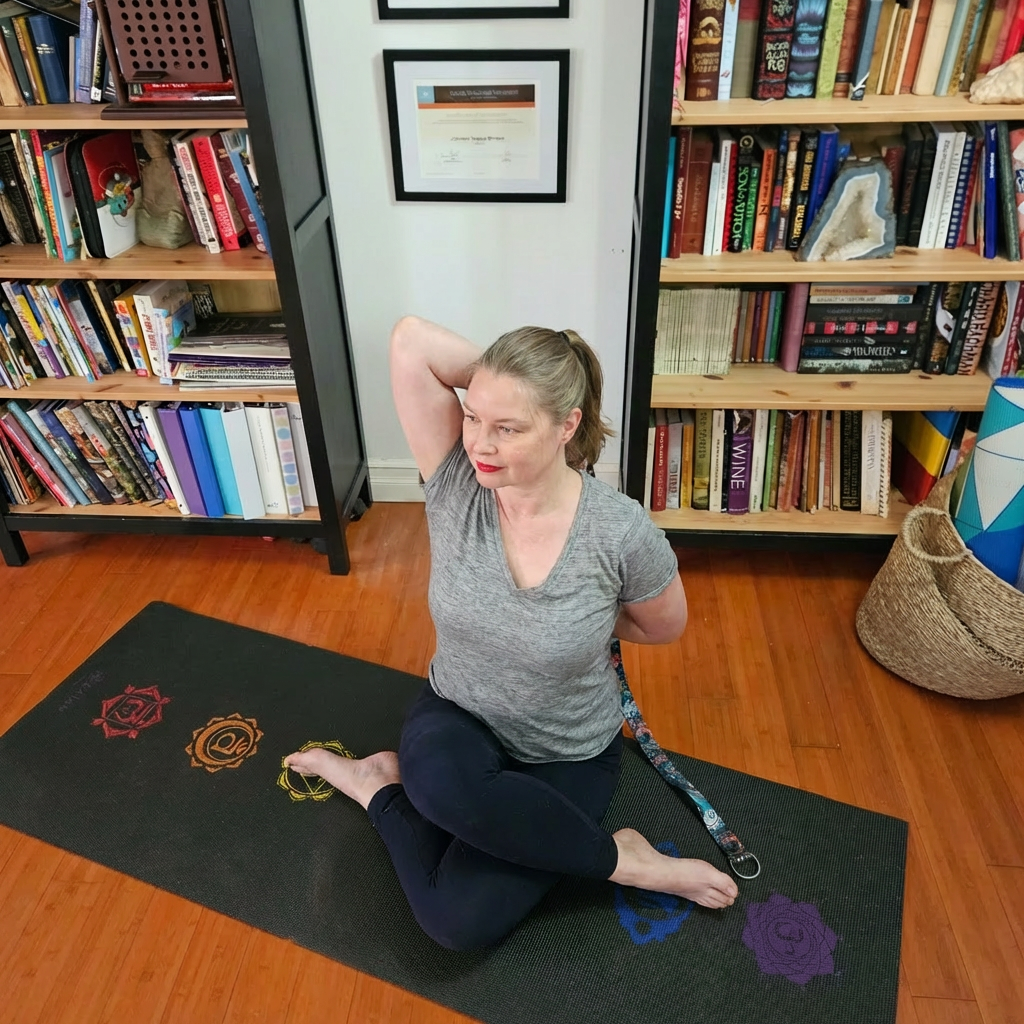
- Cow Face Pose (Gomukhasana)
∘ Opens the hips and shoulders while improving posture and flexibility.
Tips for Incorporating Your Poses
- Choose a few poses: Stick to around 3-5 poses to keep your practice manageable.
- Practice regularly: Aim for consistency, even if it’s just for a few minutes each day.
- Mix it up: Vary your routine by focusing on different goals, such as strength, flexibility, or relaxation.
- Listen to your body: Adjust poses as needed. Don’t hesitate to skip or change poses based on how you feel.
Feel free to add or change the list according to what you enjoy most in your practice! My personal favorites are Triangle pose, Tree pose, and Bridge pose.
Always ease into poses and don’t focus on looking like the picture or video; just use it as a guide. Walls are your friend if you have trouble with balance. For example you can gentle lean against the wall for stability.
People are different; some have no injuries, and some do. Men and women have pelvic bone differences. These are just a few examples of body differences and things to keep in mind when practicing yoga.
Frustration is normal and doesn’t mean you’re failing. You are trying something new and learning something unfamiliar.
There are many books and videos that teach poses. I have some on YouTube myself. My personal favorite is by Tara Fraser, Total Yoga: A Step-by-Step Guide to Yoga at Home for Everyone. I absolutely love this book for its simplicity. Years ago, I signed up for a six-week beginner’s yoga class, and this book was included with the class.
Another book I recommend is Faith with a Twist by Hillary D. Raining and Amy Nobles Dolan. This book is for those wanting to incorporate Christianity into their practice. Both books give simple how-to instructions for poses. They are available on Amazon.
Final thoughts: keep it simple; consistency is the key. Fifteen minutes a day is better than one hour every few days. Like any goal, break it down into smaller goals to keep you motivated. Yoga is a great way to help you feel better during your day.
“Move your joints everyday. You have to find your own tricks. Bury your mind deep in your heart, and watch the body move by itself.” – Sri Dharma Mittra
Discover more from JTM Life & Wellness, LLC
Subscribe to get the latest posts sent to your email.
 JTM Life & Wellness, LLC